A Cuban sandwich can start an argument before anyone takes a bite. Someone expects salami; someone else says it doesn't belong. Cuban sandwich history explains that disagreement, but it also helps you make a better lunch: the bread, balanced fillings and pressure all matter. The useful question isn't which city gets every bragging right. It's which version you're making, and how to get a crisp crust without leaving cold pork in the middle.
What a deli Cuban tells you about the sandwich
A menu name doesn't tell you every detail. You might order a Cuban expecting yellow mustard and find a sharper mustard instead. Reading the fillings gives you a better guide than assuming every deli follows one regional formula.
Pinegrove Market & Deli is a family-owned deli and butcher shop in Avondale, Jacksonville. Its pressed Cuban on the deli menu combines slow-roasted pork, honey-cured ham, deli-cut Swiss, pickles and spicy mustard on a pressed Cuban roll. That gives you a local example of the sandwich's central structure, with the shop's stated mustard choice rather than the yellow mustard commonly described in traditional versions.
For your own sandwich, that ingredient list is a useful starting point. Pork provides the main meat filling; ham brings a different cured flavor. Pickles and mustard cut through the richness. You don't need to pile everything high to taste the contrast.
Cuban sandwich history follows workers between Cuba and Florida
A tidy birthplace story is tempting. Say you're talking over lunch in Jacksonville and someone declares that Miami invented the sandwich. The history of the Cuban sandwich becomes clearer when you follow the workers and their lunch counters instead of picking a winner first.
Wikipedia's Cuban sandwich article, accessed in 2026, describes the exact origin as uncertain. People moved frequently between Cuba, Key West and Tampa in the late 1800s and early 1900s. That movement carried food traditions, but it didn't leave a complete record of who first assembled which sandwich.
The article connects early sandwiches with Cuban workers and Florida's cigar industry. It discusses accounts of workers eating similar lunches in Cuba and Key West, then traces the industry's shift to Tampa in the mid-1880s. Cuban, Spanish and Italian workers settled in Ybor City. The earliest recorded descriptions of a distinct Cuban sandwich in Ybor City and nearby West Tampa date to around 1900.
There's evidence for an earlier Cuban connection, too. The University of South Florida's account of sandwich research (2025) reports that historian Andy Huse found sandwiches on Havana menus in the 1800s. The researchers describe the Cuban predecessor as a mixto, meaning a combination, and credit Tampa with popularizing it. That supports Cuban roots without supplying an exact inventor or birth date.
Miami enters the story later. Wikipedia notes that Cuban sandwiches were common on Miami menus by the 1960s, following the arrival of many Cubans after 1959. So a fair description gives Cuba, Key West, Tampa and Miami their places. For your kitchen, the lesson is useful: a regional difference doesn't automatically make a sandwich wrong.
Tampa vs Miami Cuban: why Genoa salami belongs in the debate
Salami can surprise a guest who knows only a South Florida Cuban. For example, you might add it to a lunch sandwich and hear, “That's not how I remember it.” Naming the version before serving avoids an argument over an ingredient with a documented regional history.
Wikipedia explains that Tampa traditionally includes Genoa salami, probably because Italian immigrants lived alongside Cuban and Spanish neighbors in Ybor City. South Florida versions usually leave it out. Both Wikipedia and the University of South Florida confirm that Tampa City Council designated the “Historic Tampa Cuban Sandwich” as the city's signature sandwich in 2012. That recognition celebrates Tampa's version; it doesn't settle every origin claim.
At home, I'd use a restrained layer of salami for a Tampa-style sandwich. Its cured flavor can dominate if you treat it as the main filling. Without it, you have more room to taste the roast pork and ham. Neither choice needs an apology, but your guests will appreciate knowing which version you've made.
What makes a proper Cuban sandwich?
A sandwich can have the expected meats and still eat badly. Imagine biting through a tough baguette while the pork slips onto your plate. The solution starts with bread that compresses well and fillings spread evenly from end to end.
Wikipedia's Cuban bread article, accessed in 2026, describes a thin crust and soft center, with lard or vegetable shortening in the dough. Those features help explain why Cuban bread works so well under pressure. The inside compresses while the crust becomes crisp. If you can't find it, a light, soft-centered white loaf is a practical substitute, though the texture won't be identical.
The traditional filling described by Wikipedia is roast pork, ham, Swiss cheese, thin dill pickles and yellow mustard, with salami depending on the region. For a traditional Tampa or Miami version, I'd leave out lettuce and tomato. Wikipedia does describe those additions, along with mayonnaise, in the Key West Cuban mix. They're regional choices rather than universal requirements.
Thin meat layers are easier to bite through than a mound of thick slices. Pickles drained of excess brine add acidity without soaking the crumb, the soft interior of the bread. A modest spread of mustard keeps it from overwhelming the pork. And cheese spread across the filling helps hold the layers together as it melts.
How can you press one at home without a plancha?
A dark crust with a cold center is a common home-pressing problem. It can happen when you put a thick sandwich straight from the refrigerator into a very hot skillet. More heat isn't the answer; a thinner build and gentler heating give the filling time to catch up.
Wikipedia describes the traditional plancha as a sandwich press with smooth surfaces. It heats and compresses the bread together. A panini press can do the job, although its ridges leave a different crust pattern. You can also use a skillet with a clean, heavy, heat-safe pan resting on top of the sandwich.
A thin coating of butter or oil on the outside helps the bread brown through good contact with the pan. Moderate heat is a better starting point than a smoking skillet. The top pan needs enough weight to flatten the sandwich slightly, not enough to force the filling out. If you're using a skillet, turning the sandwich lets both faces contact the hot surface.
The useful cues are a crisp exterior and melting Swiss, not a fixed cooking time. Bread thickness and filling temperature change the timing. But those cues don't prove leftover meat is safely reheated; a thermometer handles that part.
Leftover pork needs a temperature check, not just melted cheese
Yesterday's roast can become today's Cuban, but browned bread doesn't tell you the meat's temperature. If your pork comes from the refrigerator, reheating it separately before assembly makes it easier to warm thoroughly without burning the sandwich.
USDA Food Safety and Inspection Service guidance, accessed in 2026, recommends reheating leftovers to 165°F, measured with a food thermometer. You can check the pork before assembling and check the meat filling again if it has cooled during preparation. Melted cheese isn't a substitute for that measurement.
USDA also gives refrigerated leftovers a 3-to-4-day storage window. Perishable food needs refrigeration within 2 hours, or 1 hour when the temperature is above 90°F. Those limits matter for a Jacksonville patio lunch as much as for the roast in your fridge. A smaller serving batch reduces the amount of food sitting out while everyone talks.
For a group, plan the pressing work before lunch
Say you're feeding eight people and have room to press only one sandwich at a time. The bottleneck isn't choosing salami; it's getting everyone a warm lunch together. Keeping the fillings ready and assembling close to pressing time helps prevent pickle moisture from sitting in the bread.
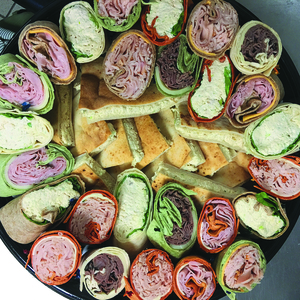
If you'd rather skip that work, Pinegrove's Cuban Platter is a relevant group option. The catering menu lists it at $50, serving 6–8 people. That's a listed serving range, not a promise about every appetite. You can use the catering inquiry page to describe your group, and call (904) 389-8655 to confirm current pricing, portions and pickup details; ordering is by phone.
For the sandwich you make yourself, bread and heat deserve as much attention as the regional label. Cuban sandwich history gives you a reason for the salami choice. A balanced build and patient press give you the lunch.